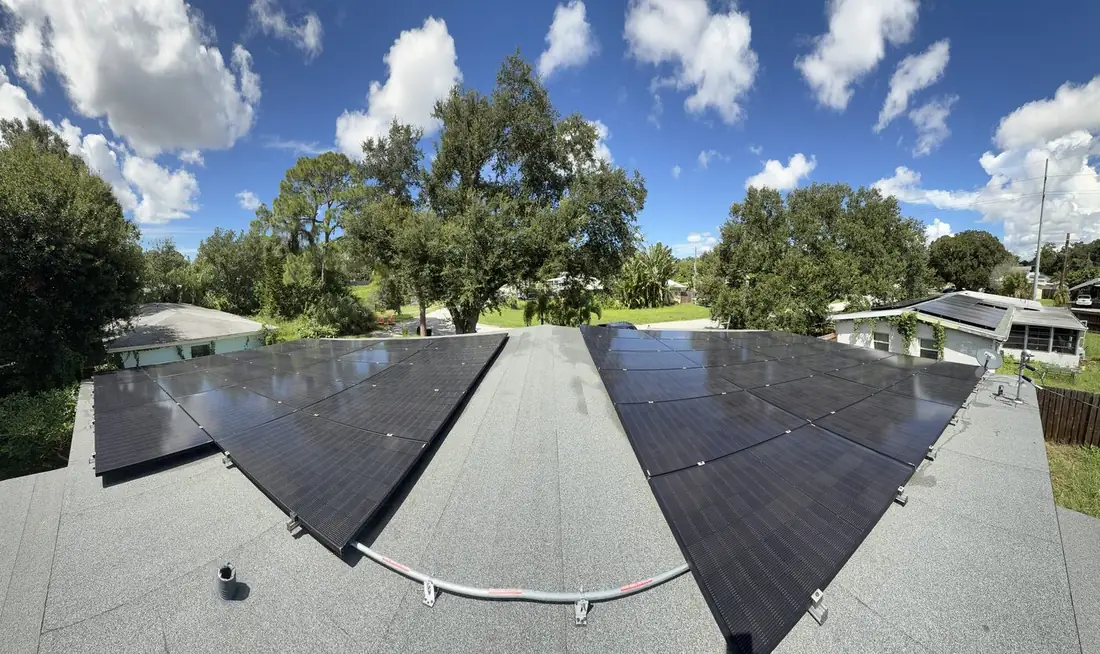
You installed solar panels to save money on electricity, and they're supposed to last 25 to 30 years. What most homeowners don't realize is that the things landing on panels every day (bird droppings, pollen, salt film, dust) aren't just blocking light. They're slowly damaging the cells underneath in ways that don't fully heal even after the dirt is removed.
Here's what the research says about what happens between cleanings, why every six months is the right interval, and why bird droppings in particular are something Q CELLS, Tesla, SolarEdge and the National Renewable Energy Laboratory all warn about.
The real problem: hot spots
When something opaque covers part of a solar cell, that cell stops producing electricity, but the cells next to it keep producing. The current from the working cells has nowhere else to go, so it forces its way through the shaded cell. That cell, designed to produce electricity, now has to absorb it. The energy turns into heat and the cell starts cooking itself.
This is called a hot spot, and it's one of the most damaging things that can happen to a solar panel over its lifetime.
Hot spots were the most common cause of degradation in NREL field data.
Based on 10 years of National Renewable Energy Laboratory field data published in 2017, hot spots accounted for 33% of module degradation cases, more than glass breakage, ribbon discoloration, encapsulant discoloration or cell breakage. Bird droppings and soiling are documented triggers.
What Q CELLS says about hot spots
Q CELLS, one of the largest residential solar brands in the country, markets a feature called "Hot-Spot Protect." On its own corporate site, the company says hot spots can heat the equipment and, in the worst case, cause the module to catch fire. That's the manufacturer telling you hot spots are serious enough to engineer protection against.
The protection helps, but it doesn't make hot spots harmless. The underlying cause, something blocking the cell, is still a problem the owner has to manage. Q CELLS, Tesla Solar and SolarEdge owner guidance recommends periodic professional cleaning, at least twice a year.
Q CELLS, Tesla Solar and SolarEdge recommend professional cleaning at least twice a year.
All three warn against DIY methods like drain cleaner, abrasive pads or pressure washers, citing the risk of scratching the anti-reflective coating.
What hot spots do to your cells
Thermal imaging of soiled panels in real-world conditions shows the small area under a dropping or shaded cell running much hotter than the clean glass around it, with the heat concentrated in the same spot every sunny day. Heat degrades every component on a panel: the silicon cells, the solder joints, the bypass diodes and the encapsulant. Sustained over months, that degradation becomes permanent. Peer-reviewed research in Renewable and Sustainable Energy Reviews describes hot spots as localized areas that can exceed several hundred degrees and calls them one of the most severe types of module degradation.
Why bird droppings are worse than any other soiling
1. They don't wash off easily
Rain rinses dust. It rarely rinses away bird droppings, which bake onto solar glass in the Florida sun and bond to the anti-reflective coating. The dropping you see today will likely still be there in three weeks, only harder and more chemically bonded.
2. They're acidic
The acid in droppings etches the anti-reflective coating, and the longer it sits the more permanent the etching. The cells underneath suffer too, with bypass diodes activating in response to the shading and accelerating localized degradation.
The math doesn't care about your roof. One dropping is a shaded cell creating a hot spot, a hot spot degrading the cells beside it, and acid etching the glass. All three get worse the longer you wait.
Why every six months is the right schedule
The Florida soiling cycle
Florida has two heavy soiling seasons: spring pollen, roughly February through May, and the back end of summer through fall, when storm-driven salt deposition and pollen return. Cleaning once after each keeps panels near full output in the months they produce the most.
The bird-dropping window
Droppings cause little permanent damage if removed within days, but become hard to remove and start etching glass after two to four weeks. You can't clean every dropping the day it lands, but a regular schedule limits how long any one of them sits.
The salt-film curve
Salt film bonds to panel glass and doesn't wash off in rain. By month six it's noticeable; by month twelve it can take multiple passes to remove and may already be affecting the coating. Six months keeps the buildup removable.
This is why we built Sevenfold Care: two scheduled visits a year, priority booking and $50 off, because twice-yearly cleaning shouldn't depend on your memory.
Why you should never walk on your panels
Solar glass handles hail, wind and heavy rain, but it cracks under concentrated point loads, and a person's weight on a knee or foot is exactly that. The damage is usually invisible at first: micro-cracks in the silicon cells that grow as the panel heats and cools each day. After a year or two they start to affect output, and after several years they can cause cell isolation, more hot spots and permanent capacity loss.
We clean with telescoping water-fed poles and soft brushes, so the glass never takes foot pressure. Pure deionized water lifts the dirt and dries spot-free, with no high pressure and no harsh chemicals.
How to know it's time
- It's been six months or more since your last professional cleaning.
- You can see droppings, pollen film or grime on the panels from the ground.
- Your monitoring app shows lower daily production than usual.
- Your electric bill has crept up while your usage stayed the same.
- You live within about five miles of the Gulf or the Bay.
- You have trees within 50 feet of the panels.
- It's spring or fall, your two natural cleaning windows.
References
- NREL 10-year field degradation data (2017), cited in "A Review of the Degradation of Photovoltaic Modules for Life Expectancy," Energies, MDPI (2021).
- "Review of degradation and failure phenomena in photovoltaic modules," Renewable and Sustainable Energy Reviews, ScienceDirect (2022).
- Hanwha Q CELLS, "Hot-Spot Protect" technology page, q-cells.co.uk.
- Tesla Solar, Hanwha Q CELLS and SolarEdge owner maintenance guidance.